How to Tackle the Socioeconomic Inequalities of Teenage Pregnancy

This is a post based on our article “Social Inequalities in Teenage Fertility Outcomes: Childbearing and Abortion Trends of Three Birth Cohorts in Finland”.


In the media, Finland is often displayed as an example of a country where society has taken big steps in ensuring equality in children’s upbringing: the world’s leading education system is free, parents are well supported financially, and able to choose between a long parental leave and working full time. At the same time their children are taken care of in one of the many public nurseries with university educated kindergarten teachers and parents only have to pay a small fraction of the costs.

When adolescents reach their teens and begin to explore elements of the adult world such as sex, it is important to ensure that they are equipped with enough information regarding sexual health, contraception and the emotions involved. Apart from a few recession years in the 1990s, sex education has been a compulsory part of the curriculum in Finland since 19701. That, among other reasons, has resulted in internationally low teenage pregnancy rates despite a temporary increase in the late 1990s2,3. In addition, contraceptives have been easily available from a variety of sources including school health centres and the public healthcare system since the early 1970s4.

Studies in the US and UK5,6 have found that teens who lack the possibility of pursuing certain careers, may wish to start childbearing at a young age because they see that as a legitimate pathway to adulthood. Perhaps the low teen pregnancy rates in Finland indicate that the policies mentioned above have been successful in providing alternative pathways to adulthood, making the remaining teen pregnancies happen due to other reasons than one’s socioeconomic position?

Although I do think that these policies are needed and should continue, it looks like they have not been very successful in decreasing the socioeconomic gap in teenage childbearing and abortions. Evidence for this is based on the results of our study looking at fertility behaviour of three birth cohorts of Finnish women when they were aged 15 to 19 (born in 1955-59, 1965-69 and 1975-79).

The likelihood of teenage childbearing or abortion was the highest for the adolescents from low socioeconomic status households, in particular if the head of the household was a manual worker. Among the teenagers who experienced a pregnancy the odds of choosing an abortion rather than childbearing were two to three times higher for teens from white-collar backgrounds, indicating a will to postpone childbearing – perhaps in order to pursue higher education and a career.

Interestingly, the socioeconomic differences were the largest for the 1960s cohort, even though they were the ones who should have enjoyed the best family planning services and sex education. The 1950s cohort was already in their teens when sex education and family planning services became compulsory in all municipalities, whereas the 1970s cohort suffered from cuts in these services due to the severe recession in the 1990s.

The results of the study do not claim that teens are better off without sex education and family planning services – in fact teen pregnancy rates started to increase soon after cuts were made to these services and started to decline again after the services were re-introduced. However, there is a need for tailored policies taking into account the different backgrounds of the adolescents. Although targeted family planning services and sex education should be in the core of these policies, it is equally important to provide support for teens who conceive regardless of whether they decide to carry the pregnancy to term. All adolescents, irrespective of their pregnancy history should be able to attend school and pursue the career of their choice.

This text has also been posted to Demotrends blog (an amazing blog I highly recommend!). For more information, check the article on the journal’s website.


References

  1. Kontula, O. The evolution of sex education and students’ sexual knowledge in Finland in the 2000s. Sex Educ. 10, 373–386 (2010).
  2. Heino, A. & Gissler, M. Induced abortions 2011. (National Institute for Health and Welfare, 2012).
  3. Vuori, A. & Gissler, M. Perinatal statistics: parturients, deliveries and newborns 2012. (National Institute for Health and Welfare, 2013).
  4. Kosunen, E. in New Views Sex. Health – Case Finl. (Lottes, I. & Kontula, O.) 70–84 (Väestöliitto, 2000).
  5. Hayford, S. R. & Guzzo, K. B. Racial and Ethnic Variation in Unmarried Young Adults’ Motivation to Avoid Pregnancy. Perspect. Sex. Reprod. Health 45, 41–51 (2013).
  6. Smith, D. M. & Roberts, R. Social inequality and young pregnancy: the causal attributions of young parents in London, UK. Health Place 17, 1054–1060 (2011).

Toisenlainen lukiovertailu

”Sijoitus voi siksi [koulun pienen koon vuoksi] vaihdella paljonkin, mutta ei koulun opetuksen taso samaan tahtiin voi vaihdella. Vertailussa auttaa paljon, jos otetaan huomioon lukion lähtökeskiarvo. Mutta pitäisi ottaa huomioon myös koulujen eri koko.” (Yle.fi 28.5.2013)

“Kokonaan toinen asia olisi yrittää mitata lukion vaikuttavuutta eli lisäarvoa tai “arvonmenetystä”: leipooko yksi lukio peruskoulun armoviitosillakin läpäisseistä kelpo ylioppilaita, ja onnistuuko toinen lukio tukahduttamaan peruskoulussa loistaneiden motivaation. Ratkaisuksi eli lähtötason paljastajaksi on tarjottu peruskoulun päättötodistusta, mutta mittarina se on varsin epätarkka. Opetushallituksen osaamistesteissä on havaittu todellisen osaamisen ja arvosanan välillä jopa kahden numeron heittoja, jotka voivat olla myös systemaattisia.” (HS.fi 29.5.2013)

Miten osaamisen ja opettamisen tasoa tulee mitata? Voidaanko kouluja, oppilaita tai opettajia asettaa paremmuusjärjestykseen ja mikäli voidaan, millaisia kriteereitä kyseisen järjestyksen luomiseen tulisi käyttää?

Lienee selvää, ettei edellä esitettyihin kysymyksiin ole yksiselitteisiä vastauksia. Siitä huolimatta joka vuosi kohistaan Helsingin Sanomien lukiovertailusta, jossa lukiot asetetaan paremmuusjärjestykseen sen mukaan, kuinka hyvin niiden oppilaat ovat keskimäärin ylioppilastutkinnossa kyseisenä vuonna pärjänneet. Joka vuosi tähän keskusteluun liittyy kritiikkiä siitä, että mittausta tulisi muuttaa ottamalla huomioon erinäisiä asioita, kuten oppilaiden lähtötaso tai koulun koko kuten yllä olevista lainauksista tulee ilmi. Viime vuonna STT päätti muuttaa sanat teoiksi ja rakensi oman lukiovertailunsa, jossa otettiin huomioon oppilaiden lähtötaso (eli peruskoulun päättötodistuksen keskiarvojen keskiarvo) lukioita vertaillessa. Ykkössijan sai lukio, joka tuotti eniten “lisäarvoa” eli jonka oppilaat pärjäsivät ylioppilastutkinnossa paremmin kuin heidän lähtötasonsa antoi olettaa.

Olimme jo pitkään ystäväni kanssa kehitelleet vastaavaa vertailua ennen kuin STT julkaisi omansa. Uutisen myötä oma vertailumme jäi pölyttymään pöytälaatikkoon. Tallensin kuitenkin STT:n vertailun avoimen datan koneelleni sateisen päivän varalle. Tänä keväänä Yle julkaisi vertailun, jossa huomioon otettiin koko 2000-luvun ylioppilastutkintotulokset. Yhdistämällä tietoja näistä kahdesta lähteestä sekä Hesarin uusimmasta lukiorankingista, loin tietokannan, jonka avulla asiaan saattoi perehtyä syvällisemmin kuin vain yhden tai kahden muuttujan avulla. Saatavilla oli tieto vuosien 2012 ja 2013 puoltoäänien keskiarvosta, koko 2000-luvun puoltoäänien keskiarvo ja keskihajonta (joista jälkimmäistä voidaan pitää mittarina lukion tuloksen tasaisuudesta siten, että pieni keskihajonta tarkoittaa tasaista tulosta ja suuri keskihajonta epätasaista), kirjoittaneiden määrä vuosina 2012 ja 2013 sekä kunta ja maakunta, jossa lukio sijaitsee. Päätin tarkastella, mitkä asiat vaikuttavat pitkäaikaiseen hyvään menestykseen (eli 2000-luvun puoltoäänien keskiarvoon).

Kun tarkastellaan edellä mainittujen muuttujien vaikutusta puoltoäänien pitkäaikaiseen keskiarvoon yksitellen lineaarisella regressiomallilla, näyttää siltä, että jokaisella niistä on merkitystä. Mitä epätasaisempia tuloksia lukio tuottaa, sitä huonommat puoltoäänet kun taas suuri koko parantaa tulosta hieman (sadan oppilaan lisäys n.1 puoltoäänen), korkea sisäänpääsykeskiarvo (yhden yksikön lisäys keskiarvossa tuottaa 2,8 puoltoääntä lisää keskimäärin) ja ruotsinkielisyys (keskimäärin 1,2 puoltoääntä enemmän kuin suomenkielisillä lukioilla) enemmän. Uuteenmaahan verrattuna kaikkien muiden maakuntien lukiot näyttävät pärjäävän huonommin, vaikkakaan ero ei aina ole tilastollisesti merkitsevä. Yli yhden puoltoäänen päässä Uudestamaasta ovat Lappi, Etelä-Pohjanmaa, Etelä-Savo, Kainuu ja Kanta-Häme.

Yleensä kuitenkin on hyödyllistä tarkastella useiden muuttujien vaikutusta yhtäaikaa sen sijaan, että pohdittaisiin jokaisen vaikutusta erikseen. Lisäsin kaikki edellä mainitut muuttujat samaan malliin ja lisäksi otin huomioon vielä sisäänpääsykesiarvon neliön, mikä käytännössä tarkoittaa sitä, ettei sen ja puoltoäänien määrän oleteta riippuvan toisistaan ainoastaan lineaarisesti. Näyttääkin siltä, että sisäänpääsykeskiarvon ja puoltoäänien välinen yhteys on melko tasainen ala- ja keskikastin lukioissa, kun taas 8,5 sisäänpääsykeskiarvon jälkeen puoltoäänien määrä ampaisee hurjaan nousuun. Ruotsinkieliset lukiot pärjäävät keskimäärin 1,5 puoltoääntä paremmin kuin suomenkieliset. Tasaista tulosta tuottavat lukiot pärjäävät keskimäärin paremmin kuin epätasaista tuottavat. Lukion koolla ja sijainnilla ei enää juurikaan ole merkitystä, kun sisäänpääsykeskiarvo, tuloksen tasaisuus ja ruotsinkielisyys on otettu huomioon.

keskiarvo puoltoaanet
Sisäänpääsykeskiarvon vaikutus puoltoäänien määrään, kun maakunta on uusimaa ja lukion koko sekä tuloksen tasaisuus on vakioitu keskiarvoihinsa.

taulukko mallit


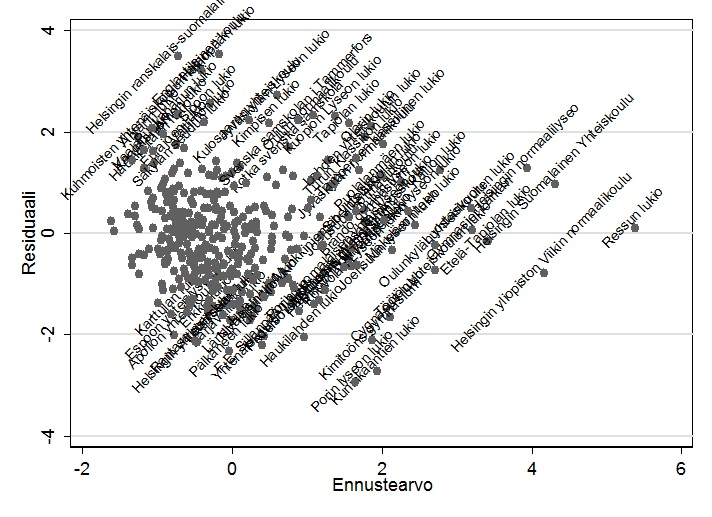
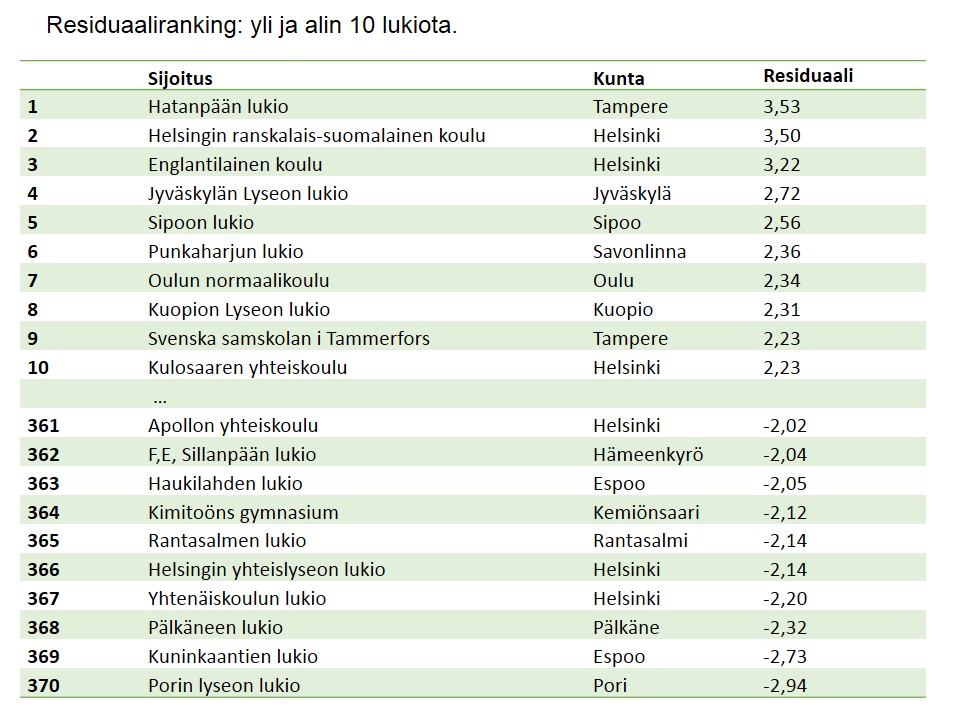
Mikä lukio sitten on paras lukio? Mikäli halutaan selvittää, mikä lukio tuottaa eniten ”lisäarvoa” opiskelijalle, eli tuottaa mahdollisimman hyvät puoltoäänet ottaen huomioon opiskelijoiden lähtötason, voidaan tarkastella viimeisimmän regressiomallin residuaaleja. Ne kertovat, mitkä lukiot pärjäävät paremmin kuin regressiomalli keskimäärin olettaa ja mitkä huonommin. Residuaalitarkastelun perusteella näyttää siltä, että perinteisesti huippuina pidetyt lukiot pärjäävät juuri niin hyvin kuin niiden voi olettaakin pärjäävän: esimerkiksi Ressun ja SYK:in residuaalit ovat lähellä nollaa, mikä on merkki siitä. Mitä kauempana nollasta, sitä poikkeavampia tuloksia lukio tuottaa.

residuaalit taulukko resuduaalit

Kuinka vakavasti tämä analyysi tulisi ottaa? Käyttämässäni datassa on useita puutteita. On kyseenalaista, voinko päätellä em. asioita sisäänpääsykeskiarvon ja lukion koon suhteen, sillä ne ovat tiedossa vain vuosilta 2012 ja/tai 2013, kun taas puoltoäänien määrä on koko 2000-luvun keskiarvo. Ideaalitilanteessa tulisi käyttää sisäänpääsykeskiarvoja ja kokoa vastaavilta vuosilta. Oletan kuitenkin, etteivät nämä ole muuttuneen niin dramaattisesti, etteikö ainakin suuntaa-antavia tuloksia voitaisi niiden perusteella laskea. Lisäksi malleissa ovat mukana vain ne 370 lukiota, joilta saatavissa kaikki tiedot vaikka Suomessa on yli 400 lukiota. Tässä analyysissa esimerkiksi kaikki aikuislinjat puuttuvat. Näiden lisäksi ollaan vielä jo alussa mainitsemieni perustavanlaatuisten mittaamiseen liittyvien ongelmien äärellä.

Neuvoni onkin olla ottamatta tätä (tai mitään muutakaan) rankingia ainoana oikeana totuutena. Etenkin jokaisen lukiovalintaa pohtivan oppilaan tulisi muistaa, ettei tällaisilla agregaattitason vertailuilla voida sanoa mitään yksilötason tuloksesta. Lisäksi painottamalla rankingissa erilaisia asioita saadaan erilaisia tuloksia, joiden hyödyllisyys vaihtelee riippuen siitä, mitä niiden avulla halutaan sanoa. Toisaalta, vaikka peruskoulun päättötodistus ei olisi hyvä osaamismittari, veikkaan, että ilmapiiri koulussa, johon mennään keskiarvolla 9,5 on hyvin erilainen kuin koulussa, jossa kuka tahansa pyrkijä pääsee sisään. Kympin oppilaiden opiskelumotivaatio ja luottamus omaan kouluosaamiseensa lienevät ihan eri tasoa kuin vitosen oppilaiden riippumatta siitä, miten nämä numerot mittaavat “todellista” osaamista. Ehkäpä rankingit kertovatkin jotain lähinnä koulun opiskelumyönteisestä ilmapiiristä?

Numbers don’t lie, but news do. An analysis of news coverage of polls in Finland.

Inspired by a friend’s rant in Facebook regarding the media’s way of presenting poll results and by a public lecture of Nate Silver at LSE, where similar problems were discussed, I decided to investigate the news regarding the popularity of the largest parties in Finland. I wondered, what the polls actually say about the popularity and is that reflected in the language used in the news.

I limit my mini-investigation to the four largest parties: Social-democrats (SDP), National Coalition Party a.k.a. Kokoomus (KOK), Centre Party a.k.a. Keskusta (KESK) and True Finns Party a.k.a. Perussuomalaiset (PS), because the polls usually only give the margin of error for the largest parties. Therefore, I can only try to estimate the accuracy of popularity of these parties.

I searched for a few latest polls in the two biggest news institutions’ websites in Finland: Yle.fi (the National Broadcasting Company) and HS.fi of Helsingin Sanomat (a broadsheet with the largest number of readers). In the end I chose seven polls, conducted between December 2012 and April 2013. Yle uses Taloustutkimus and HS TNS Gallup to conduct the analysis.

polls

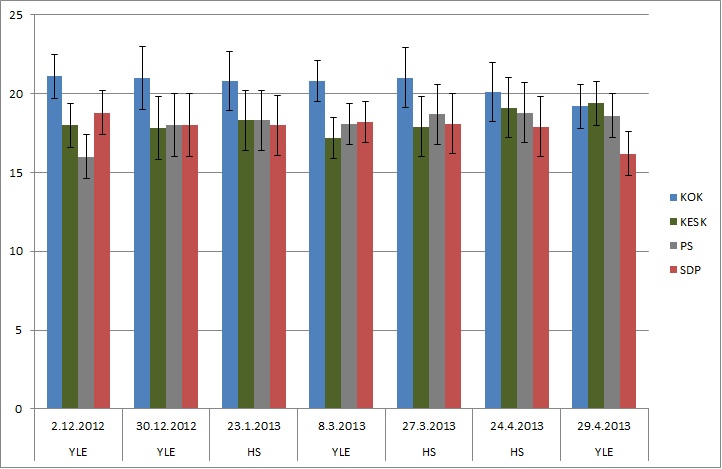
The figure clearly shows that if we consider the margins of error reported by Yle and HS, most of these polls cannot distinguish, which one of these four parties is the most popular one. However, arriving to this conclusion is not easy due to four reasons:

  1. Margin of error is only reported for “the biggest” parties, although I couldn’t find a definition of what “the biggest parties” mean. I assume it means these four, since there is a significant gap between these and the 5th largest party popularity in all polls. In the latest HS poll (24 April 2013) the margin was not reported at all.
  2. Yle polls report that the results of the polls are “more accurate than what the margin of error would imply” due to calibration methods they use, but this is not explained further. Therefore, I chose to ignore this information here.
  3. In order to understand, what margin of error means, one has to know that it actually is a 95% confidence interval and that this interval (in simple terms) means that “we are 95% confident that the value in the total population is within this range”. In other words, if we drew an infinite number of random samples from the Finnish population and asked, which party people support, in 95/100 cases we would get an estimate within the range of 95% confidence interval. In 5/100 cases the estimate would be outside the range. The interval is reported, since as long as we don’t actually ask everyone, we cannot be entirely certain that our estimate is correct. However, we can provide information on how certain we are. Wide range implies more uncertainty than a narrow range.
  4. Most importantly: the way these polls are reported in the media is almost entirely inaccurate. I will elaborate this claim below.

The first poll (Yle 2 Dec 2012) was titled “Support for Centre Party in rapid increase“, which is not far from truth, since their popularity was 2.5%-points higher than in a previous poll and the margin of error was 1.4%-points. Therefore the overlap of the 95% confidence interval is marginal: the upper limit for the old poll’s estimate is 16.9% and the lower limit for this poll’s estimate is 16.6%. So, maybe their support actually has increased. Later they state that KOK is clearly the largest party, which is not the case, not at least clearly: looking at the figure we can see that the confidence intervals of KOK and SDP overlap. Therefore, the difference in their popularity might be only a coincidence (or noise) due to sampling. In another sample we might have gotten estimates presenting similar popularity for the two, or even higher percentages for SDP. The correct interpretation thus is: KOK is more popular than PS or KESK, but not significantly different from SDP. SDP seems to be more popular than PS but we’re not confident that there is a significant difference between PS and KESK or SDP and KESK.

The reasoning for all of the polls is similar, so I won’t present it in as much detail as above for the rest of the polls. Instead I’ll focus on the most inaccurate reports I found. If you’re interested in comparing these further, please take a look at the list of links below. As long as you have fluent Finnish skills, you should be able to do it based on this blog post.

The Centre Party is the second most popular” (HS 24 April 2013)*. Really? Looking at the figure, we quickly observe that the popularity of all four parties is really similar. We cannot even distinguish between the most and the least popular among these four — all the confidence intervals overlap. Thus, one should say: according to the latest poll, all the four biggest parties have similar levels of support.

The Centre Party is the most popular, SDP crashed” (Yle 29 April 2013). Guess what? I don’t agree with the statement. It indeed looks like KESK is more popular than SDP, but based on these results, it is impossible to say, whether it is KESK, KOK or PS, which currently is the most popular. The estimates differ only a tiny bit and the confidence intervals clearly overlap. The statement is not just exaggerating. It is false. What about SDP then, did it crash? Well, I don’t think so. The point estimate of their popularity is indeed lower than it has been in previous Yle polls in the figure. However, we have no way of knowing, if that was due to chance (remember the sampling thing!) or if there actually is a difference, since the confidence intervals overlap in all but the earliest poll in 2 December 2012. Therefore, my interpretation of this poll is: there is little difference in popularity of KESK, KOK and PS, whereas SDP may be less popular than the three other parties and also less popular than it was in the beginning of December 2012.

Okay, the rest of the interpretations you have to conduct yourself. I’m left wondering, why false information is so commonly presented in the media. Is it due to lack of understanding of statistics? Or maybe due to a belief that people are not interested in news, which do not rank the parties? Would it be so bad to truthfully say that we don’t know, which party among certain candidates currently is the most popular? I cannot think of a reason, which justifies false statements, when the journalist clearly should know better.

* If there’s anything lost in translation, blame me, I was the one, who translated these from Finnish to English.

Links to original news articles

Margins of error:

  • Yle 2 Dec ±1.4%-points
  • Yle 30 Dec ±2%-points
  • Yle 8 Mar ±1.3%-points
  • Yle 29 Apr ±1.4%-points
  • HS 23 Jan ±”less than 2″%-points –> I assumed 1.9%-points
  • HS 27 Mar ±”less than 2″%-points –> I assumed 1.9%-points
  • HS 24 Apr not reported –> I assumed 1.9%-points

Miksi lyöt lyötyä Päivi Räsänen? — Perustietoa raskaudenkeskeytyksistä Suomessa

Helmikuun viimeisenä päivänä A-studiossa käsiteltiin kristillisdemokraattien abortteihin liittyviä lakialotteita, joista toinen vaatii lääkäreille oikeutta kieltäytyä suorittamasta raskaudenkeskeytystä, mikäli se on vastoin heidän (kristilistä) vakaumustaan ja toinen vaatii sikiön sairauden vuoksi suoritettavien aborttien raskausviikkorajan alentamista 24 viikosta 20 viikkoon. Aborttilain tiukennusta nämä poliitikot perustelevat halulla vähentää abortteja ja erityisesti jälkimmäistä sillä, että nykymenetelmillä voidaan 22 raskausviikon jälkeen syntyneitä keskosia voidaan pitää hengissä, joten on väärin abortoida sikiö, joka periaatteessa on elinkelpoinen. Kuulostaa vakavalta, on siis hyvä tarkastella, millaisesta ongelmasta oikeastaan on kyse.

Suomessa raskauden keskeyttäminen on sallittu sosiaalisista ja lääketieteellisistä syistä. Edellisten vuoksi raskaus voidaan kahden lääkärin suostumuksesta keskeyttää ennen 12. raskausviikon päättymistä tai ennen 20. raskausviikon päättymistä erityisen painavista sosiaalisistä syistä Valviran päätöksellä. Mikäli sikiöllä todetaan vakava sairaus, keskeyttäminen on mahdollista 24. raskausviikon loppuun saakka. Mikäli naisen henki tai terveys on vaarassa, ylärajaa ei ole.

Alla on kuvio, jossa ovat mukana vuosittain Suomessa tehdyt abortit ja synnytykset (lähde THL). Edelliset on jaoteltu ryhmiin raskauden keston mukaa. Kuviosta näkyy, että lähes kaikki abortit Suomessa tehdään jo ennen 8. raskausviikon päättymistä. Päivi Räsänen on huolissaan niistä noin sadasta vuosittaisesta keskeytyksestä, jotka tehdään 20. raskausviikon alkamisen jälkeen. Suomessa tehdään nykyisin vuosittain noin 10 000 aborttia. Se vastaa alle 15 prosenttia sellaisista raskauksista, jotka eivät pääty keskenmenoon. Prosentti raskaudenkeskeytyksistä tehdään 20. raskausviikon jälkeen. Osuuus on niin pieni, ettei sitä meinaa edes a.o. kuviosta nähdä, vaikka nämä keskeytykset on merkitty eri värillä kuin muut kuvion raskaudet.


Raskaudenkeskeytykset ja synnytykset

Useimmat abortit tehdään, koska alkanut raskaus ei ollut toivottu. Tästä ei kuitenkaan ole kyse niiden raskaudenkeskeytysten kohdalla, joita vastaan KD on lähtenyt taistelemaan. Nämä keskeytykset tehdään, koska sikiö on vakavasti sairas. Osa vakavista sairauksista voidaan varmuudella diagnosoida vasta 22. raskausviikolla, joten rajan laskeminen ei ole lääketieteellisesti perusteltua. En ymmärrä, miksi KD haluaa lyödä Raamatulla vanhempia, jotka varmasti ovat elämänsä vaikeimman ratkaisun edessä päätyessään keskeyttämään toivotun raskauden sikiön vakavan sairauden vuoksi. Vaikka terve keskonen voidaan pitää hengissä jo 22. raskausviikon jälkeen, abortoidut sikiöt eivät kuulu tähän ryhmään, sillä ne eivät ole terveitä.

Tutkimukset ovat osoittaneet, etteivät abortit vähene lakeja tiukentamalla. Ainoa tehokas tapa vähentää abortteja on ehkäisy. Raskaudenehkäisyvälineitä tulee olla saatavilla helposti ja edullisesti. Ihmisten on myös osattava käyttää niitä, joten koulutukseen ja tiedotukseen tulee panostaa. Toinen tehokas keino on taata neuvontaa ja tukipalveluita naisille, jotka ovat abortin juuri hankkineet. Etenkin jälkimmäisessä on Suomessa puutteita.

Ehdotan, että kaikki, jotka ovat suomalaisista (kansainvälisesti muuten melko alhaisista) raskaudenkeskeytysluvuista huolissaan, keskittäisivät voimavaransa ehkäisyneuvontaan, abortin jälkeiseen uskonnollisesta vakaumuksesta vapaaseen neuvontaan sekä köyhyyden poistamiseen. Tällöin varmasti raskaudenkeskeytykset vähenisivät entisestään.

Koska emme elä maailmassa, jossa sattumia ja vahinkoja ei tapahdu, abortteja tullaan varmasti aina jonkin verran tekemään. Siitä ei kuitenkaan tarvitse olla huolissaan niin kauan kuin turvallisia raskaudenkeskeytyspalveluita on saatavilla ja abortin jälkeistä apua tarjotaan niille naisille, jotka sellaista kaipaavat.

Linkkejä

How research becomes populism – Abortion debate in the Finnish Parliament

Liberal abortion legislation was introduced in Finland in 1970. Every now and then, there is discussion regarding, whether the law should be changed in any way. Some would like to see a day, when abortion is available on request (as in Sweden for instance) and others wish to make it more difficult to obtain abortions.

Recently, a few members of parliament from the Christian party, the Centre party and the True Finns party suggested that the legislation should be changed  so that medical doctors and other hospital personnel should be given a right to refuse performing abortions, if that’s against their conviction.

Last Thursday, the parliament discussed the suggestion. Quite rapidly the discussion shifted from the rights of hospital staff into whether abortions are morally justified. An MP from the True Finns party, Mika Niikko, referred to a study showing that more than 50 percent of the women, who went through a termination of pregnancy were depressed a year after the termination and that two percent suffered from severe depression. Later he tells that the study was conducted by “a researcher called Söderberg” and also mentions that there is a Finnish study by Gissler, Hemminki and Lönnqvist that found the risk of suicide being three times higher for women, who had had an abortion, compared to the women, who had a childbirth.

Given that I have worked on abortion-related topics for a while, the results of the studies seemed somewhat surprising to me and I decided to track down these papers. Since the citations are not more specific than what I’ve described above, I cannot be sure I found the right papers, but I managed to identify two, which fit the criteria (Söderberg et al.; Gissler et al.). After having looked at the results of these studies, I have to say I’m quite concerned about the relationship between academic research and policy making.

The paper by Söderberg and colleagues is a study of 854 women, who had had an abortion in Malmö, Sweden in 1989. The researchers identified a case group of 139 women that had experienced emotional distress and doubts regarding abortion decision and compared them to a control group of 114 women not having these feelings. Given that I only have access to an not-so-clearly-written abstract rather than a full text, I cannot say much about the study design, but the conclusions of the study are clear: the researchers identified risk factors of experiencing emotional distress (such as poor support from family and friends and underlying ambivalent attitude to abortion) and state “[t]he risk factors identified suggest that it may be possible to ameliorate or even prevent such distress”.

The other study compared suicides after pregnancy in Finland between 1987 and 1994. The researchers were able to identify 73 suicides within one year after the end of the 667,572 pregnancies observed during the study period. Women, whose pregnancy had ended in abortion, were six times more likely to commit a suicide than women, who had a childbirth. The researchers state clearly at the end of the paper that the study was not able to study causality between these two events, because they had no information of pre-pregnancy mental health conditions of the women. Thus, the causal relationship could go either way: suicides and abortions are caused by similar things or abortions cause mental health problems to some women. In addition, I’d bear in mind the small number of suicides observed, which adds uncertainty to any conclusions.

Had Niikko read a more recent paper from Gissler and colleagues, he would have discovered that having mental health problems is associated with a higher risk of abortion. Therefore it seems like experiencing difficult life events is associated with higher risk of abortion rather than the other way around. Also this paper ends with caution: more research is needed, before claiming causality in this complex relationship. Many previous studies have suffered from severe problems in research design and thus cannot be trusted.

So, the studies Niikko referred to were from late 1980s and early 1990s. It goes without saying that they are old and that there are more recent studies he could have referred to. Moreover, the results of the studies were clearly misinterpreted. The really sad part is that in the discussion Niikko was the only MP, who even tried to refer to academic studies to justify his point of view.

Where are the policy implications of policy relevant academic studies hiding?

The Cruel World of Birth Lottery

Last Monday an interesting series of documentaries called  Why Poverty? started on BBC (FYI: also broadcasted by YLE in Finland). The first film was called Welcome 2 the World – 4 Born Every Second. As the title suggests, the film was about babies, their mothers in different parts of the world, and their struggle of survival in circumstances that carry the highest risk of maternal and child mortality.

The film tells a story of pregnant women living in poverty in countries such as Sierra Leone, Cambodia, the US, and UK. Even thinking about the stillborn babies, complications and suffering presented still brings tears to my eyes. This is probably one of the most depressing, and yet, one of the most interesting documentaries I’ve ever seen.

According to the UN and WHO, 800 women die annually from preventable causes related to pregnancy and childbirth, due to lack of skilled medical staff, resources, or knowledge on reproductive health. The causes of death most commonly are bleeding, infections, high blood pressure, or unsafe abortion. 99 percent of all maternal deaths occur in the developing world, mostly in Sub-Saharan Africa. There are three million infants that die annually in addition to 2.6 million stillbirths. Within countries, the poorest women and their children in rural areas carry a higher risk of death than others.

These problems still exist, since there are not enough money to organise sufficient family planning services and education in many countries. The level of the family planning funds has declined between 2000 and 2008, according to the UN, despite tho growing need for help. Although maternal mortality has dropped worldwide by almost 50 percent between 1990 and 2010, more funds are needed to help the most deprived areas.

The film brought alive the facts described above. There were two stories that struck me the most. First, there was a pregnant Cambodian mother, infected by HIV, taking care of her biological son and a younger adopted girl.Their only mean of survival was to send the son to collect garbage (instead of going to school) to get money to feed the family. Finally, she gives birth to her new baby, Ly Ly and her 12-year-old son makes a commitment to continue collecting garbage, so that his sisters could go to school and eventually have a better life. However, two months after her birthday, Ly Ly dies. This allows the mother to go work in a construction site, and thus her son gets to go to school. The brutality of the situation really struck me. The youngest member of the family had to die to allow the others to have a little bit better chance in life.

The second thing that opened my eyes was a story about 22-year-old Londoner, who was a single mom for a girl and a boy, who had different fathers. Despite the lack of help from the boy’s father, she was able to provide food, shelter and an education for her family. Despite the fact that in the UK she might be considered poor, the chances of her children to live a normal life were many times better than any of the other children in the film. She was the only mother in the film saying that she has everything she needs and that she is happy.

I’m not trying to say that inequalities do not exist in the Western world, since that would not be true. The point I’m trying to make is that despite the problems that always exist no matter what we do, inequalities can be reduced to a lot smaller level than what we experience worldwide right now. It is just a matter of political decisions and allocation of resources. We should be more willing to share. Improving the condition of young children and their families is a good place to start.

I recommend watching the film (please see the links below).

Sources

UN Millenniun Development Goal reports 2010 and 2012 (PDF)
WHO Maternal Mortality fact sheet, May 2012
WHO Trends in Maternal Mortality: 1990 to 2010 (PDF)

Links

Kuntavaalit 2012: kuka voitti?

Viime kuntavaalien jälkeen keskusteltiin pitkään, millaisesta jytkystä Perussuomalaisten kannatuksessa tällä kertaa oli kyse. Vaali-illan tiimellyksessä mainittiin ainakin semi-jytky, pikkujytky ja jööti. Jotta tätä kammottavaa sanaa ei tarvitsisi enää tulosten analysoinnissa mainita, päätin ottaa selvää, ketkä näissä vaaleissa todella voittivat.

Vaikka niin kutsuttu nukkuvien puolue oli monien keskustelijoiden mielestä avainasemassa, en keskity äänestämättäjättäneiden analisointiin. Syitä tähän on kaksi. Ensinnäkin valta on demokratiassa niillä toimijoilla, joiden suhteellinen ääniosuus on suurempi kuin muiden. Toiseksi kuntavaalien äänestysprosentti ei itse asiassa ollut poikkeuksellisen alhainen.

Vertaan vuoden 2012 kuntavaalien tuloksia paitsi edellisiin kunnallisvaaleihin, myös viime vuoden eduskuntavaaleihin. Vaikka kyseessä on erilaiset vaalit, jolloin vertailuun pitää suhtautua varauksella, muuttivat 2011 eduskuntavaalit Suomen puoluekentää niin radikaalisti PerSujen rakettimaisen nousun myötä, ettei vertailua voi jättää tekemättäkään.

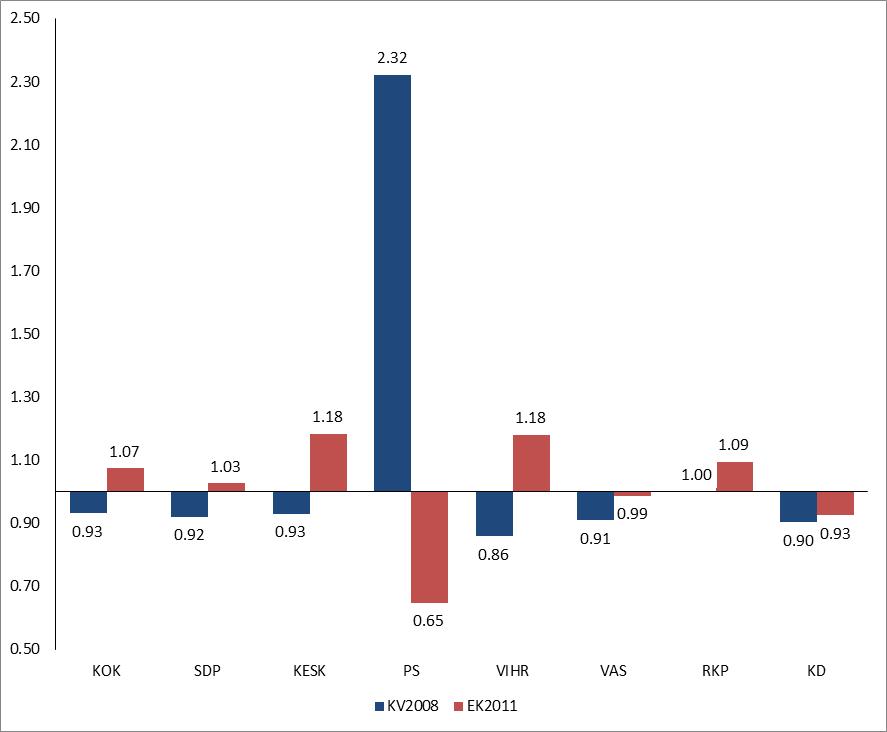
Kuva 1 näyttää puolueiden kannatuksen kuntavaaleissa 2012 suhteessa niiden kannatukseen edellisissä kunta- ja eduskuntavaaleissa. Verrattuna edellisiin kuntavaalehin, Perusuomalaiset yli kaksinkertaistivat suhteellisen äänisaaliinsa, mutta verrattuna eduskuntavaaleihin 2011, kannatus oli 0.65-kertainen eli 35 prosenttia pienempi.

Kuntavaalit 2012
Kuva 1. Puolueiden suhteellinen kannatus verrattuna kuntavaaleihin 2008 ja eduskuntavaaleihin 2012.

Verrattuna viime kuntavaaleihin kaikkien muiden puolueiden paitsi PerSujen kannatus laski. Tämä ei ole yllättävää, kunhan pidetään mielessä, että käsittelemme suhteellisia lukuja. Kun kentälle ilmestyy uusi toimija, joka kahmii suhteellisesti enemmän ääniä kuin koskaan aikaisemmin, muiden puolueiden suhteellinen kannatusosuus väistämättä laskee. Verrattuna eduskuntavaaleihin, Perussuomalaisten ja Kristillisdemokraattien kannatus laski ja Vasemmistoliiton pysyi jokseenkin samana. Kaikkien muiden puolueiden kannatus nousi, vaikkakin vaatimattomasti.

Näyttää siltä, että Perussuomalaisten viime eduskuntavaaleissa aloittama nousu on (tulkinnasta riippuen) kääntynyt laskuun tai vähintäänkin hidastunut. Suomalainen puoluekenttä on palaamassa takaisin tilanteeseen, jossa se oli ennen jytkyä.

Kuva 2. Puolueiden suhteellinen ääniosuus sekä suhteellinen osuus valtuustopaikoista.

Toinen jännittävä kuntavaalimatematiikkaan liittyvä huomio on, että 18 prosentin kannatuksella Keskusta onnistui kahmimaan itselleen kolmanneksen Suomen valtuustopaikoista (kuva 2). Tämä johtuu siitä, että pienissä kunnissa on enemmän valtuustopaikkoja äänestäjää kohden kuin suurissa ja Keskustan kannatus on perinteisesti vahvimmillaan maaseudulla. Huolimatta tästä selityksestä, en voi olla miettimättä, millaisia vaikutuksia tällä on puolueiden näkyvyyteen ihmisten arjessa tai kuntauudistuksen edistämiseen paikallistasolla.