SOC-MISC recruitment: Project manager 3 years fixed-term contract from 1 September 2024 (with possibility of extension)

ADMINISTRATIVE AND FINANCIAL COORDINATOR FOR SCIENTIFIC PROJECTS 

Category A – project manager 2nd category – BAP J 

3-year fixed-term contract (renewable until 31 December 2028) 

Description of the employer 

L’Institut national d’études démographiques (INED) is a public scientific and technological institution in France. Its mission is to conduct research on various demographic issues (such as fertility and family, health and mortality, and migration) and to inform the public and researchers of current developments in the field. INED has 250 staff members (including tenured and contractual researchers and other staff members, as well as PhD students) and it also hosts many affiliated researchers. INED works with a wide network of national and international research partners. 

Description of the department 

The candidate will work within the International Relations and Partnerships Department (DRIP). The DRIP develops INED’s relations with French, European and international actors playing a role in the demographic field or in the financing of research projects. It also coordinates the implementation of INED’s policy in European and international actions and relations, thus strengthening and structuring partnerships in France, Europe and internationally. In particular, the DRIP is responsible for management of research contracts and partnerships during the lifetime of each project from initial set-up to the end (contract negotiation, final reports, monitoring, etc.) including coordinating actions between the various departments (legal, budgetary, human resources, surveys, and statistical methods). 

Description of the projects 

ERC Starting Grant Social Inequalities in the Risk of Attermath of Miscarriage (SOC-MISC) (50% of time). 

ERC Starting Grant projects are funded by the European Research Council (ERC) and enable early-career researchers to build their research teams around ambitious projects that address innovative scientific issues or challenges not previously addressed. Coordinated by the principal investigator (PI) Heini Väisänen, the SOC-MISC project analyses how social inequalities affect the risk of miscarriage, how miscarriage can exacerbate social inequalities in population health, and how context shapes these experiences in three countries: Finland, France and the UK. The project is hosted at INED’s Sexual and Reproductive Health and Rights Unit (UR14) and it collaborates with partner institutions in Finland (University of Helsinki and Finnish Institute for Health and Welfare (THL)) and the UK (University of St Andrews). 

Future investment programs (50% of time).

The candidate will coordinate the iPOPs (Individuals, Populations, Societies) laboratory of excellence (Labex), whose partners are Paris I Panthéon-Sorbonne University, Bordeaux University, Paris Nanterre University, Strasbourg University and Paris University (formerly Paris Descartes University). The laboratory focuses on social inequalities. Its aim is to support the development of partnerships between research laboratories and teaching establishments specializing in population sciences in France and overseas; to strengthen the training of students and young researchers; and to ensure the transfer of knowledge and expertise in particular through participation in and support for scientific conferences and seminars. 

The candidate recruited will be responsible for the administrative and financial management of the Ecole des Hautes Études en Démographie (EUR HED), coordinated by Paris 1 University and of which Ined is a partner. The school coordinates a national network of training possibilities, including courses and research projects, for masters and doctoral students. INED is in charge of the doctoral part. 

Job description 

The tasks of the coordinator include: 

  1. Project management: project’s overall schedule, coordinating the schedule of the various stakeholders with the principal investigator of each project working in both French and English; 
  2. Organization of meetings and events, writing meeting notes with the Administrative Assistants both in French and English; 
  3. Preparing budgets, monitoring budgetary affairs and drafting financial statements in collaboration with Finance department and administrator of the research unit both in French and English; 
  4. Monitoring of contracts and agreements with the Legal department and DRIP both in French and English; 
  5. Coordination of the ERC project consortium in collaboration with the principal investigator of the ERC project working only in English; 
  6. Writing reports with The principal investigator of each project in French and English; 
  7. Preparation of regulatory files (ongoing ERC monitoring, CNIL, CESREES, ethics committees, data access requests) in collaboration with the legal department; IT and Information Systems department; Data Protection Officer in French and English; 
  8. Management of external communication tools (website, social networks) and collaborative work tools (cloud, mailing list) with the Communications Department, the IT and Information Systems Department working both in French and English; 
  9. Document management (organising, filing, documenting) both in French and English; 
  10. Organising EUR HED training events (managing speakers and participants) only in French. 

Profile of the candidate 

Educated at Master’s level or equivalent, the candidate must have strong coordination skills, an interest in budget management, as well as good writing and teamwork skills. Experience working in academic institutions and/or European and/or international project management is an advantage. The candidate must speak and write French and English at least at B2 level: the candidate must be able to attend meetings, write reports and update websites in English and French. 

Terms of contract

Starting Date: 1 September 2024. Full-time, 3-year fixed-term contract (possibility of extension until 31 December 2028).

Salary: based on previous work experience (between €2,573 and €3,161 gross per month).

Other information:

  • Job location: Ined, Campus Condorcet (Metro line 12: Front Populaire station).
  • Remote working is possible maximum of 2 days per week.
  • Benefits: Company restaurant – staff association.

Application Process

Applications must include the following:

  • Curriculum vitae
  • Cover letter (max. 2 pages)

Applications should include reference “Administrative and financial coordinator for scientific projects”, and should be sent to Sandrine Dauphin (sandrine.dauphin@ined.fr) and Heini Väisänen (heini.vaisanen@ined.fr ) copying in recrutements@ined.fr

Applications Deadline: 20 July 2024.

If you have any questions, please contact Sandrine Dauphin (sandrine.dauphin@ined.fr ) and Heini Väisänen (heini.vaisanen@ined.fr ) under reference “Question: Administrative and financial coordinator for scientific projects”.
SOC-MISC recruitment: project manager

We are looking for a project manager to work 50% of time for my ERC project Social Inequalities in the Risk and Aftermath of Miscarriage and 50% of time on a large fertility survey conducted at Ined.

We are looking for a candidate with at least a master’s level education. More information here. Knowledge of French is needed for this post, so the job ad is published in French.

SOC-MISC: Recruiting for a researcher position

Exciting news: the recruitement for my project Social Inequalities in the Risk and Aftermath of Miscarriage has started. The project will start on 1 January 2024.

In the first instance we are looking for a researcher (initially for 3 years, but with a possible extention until the end of the project on 31 December 2028). More details below. Please do contact me if you have any questions.

Description of the employer

L’Institut national d’études démographiques (INED) is a public scientific and technological institution in France. Its mission is to conduct research on various demographic issues (such as fertility and family, health and mortality, and migration) and to inform the public and researchers of current developments in the field. INED has 250 staff members (including tenured and contractual researchers and other staff members, as well as PhD students) and it also hosts many affiliated researchers. INED works with a wide network of national and international research partners.

Context of the job

We are looking for a researcher to work in the “Social Inequalities in the risk and aftermath of miscarriage (SOC-MISC)” project financed by the European Union (ERC Starting Grant, Horizon Europe Programme, Grant agreement ID: 101077594). The principal investigator (PI) of the project is Dr Heini Väisänen.

The researcher will be working as part of the SOC-MISC team, which is hosted at INED in the Sexual and Reproductive Health and Rights research unit, and which collaborates with partner institutions in Finland (University of Helsinki and the Finnish Institute for Health and Welfare) and the UK (University of St Andrews).

One in four women experience a miscarriage. Loss of pregnancy may affect fertility intentions and lead to adverse mental and physical health. Yet, we know little about how social inequalities affect the risk of miscarriage; how miscarriages may exacerbate social inequalities in population health; or how context shapes these experiences. Thus, the project will:

  • Analyse underreporting patterns of miscarriage and use this information in further analyses to obtain more reliable results than before.
  • Show how social inequalities affect miscarriage risk over the life course.
  • Establish how health consequences of miscarriage depend on one’s social background and may widen social inequalities in health.
  • Uncover the role of context in social inequalities in miscarriage.

We will use population registers and surveys in Finland, France and the UK to examine the issue. The project will lead to a better understanding of miscarriage and make policy recommendations.

Main tasks of the researcher

The researcher brings methodological and substantive expertise to the project. The researcher will use quantitative methods, such as regression models, multi-level analysis, path analysis, and/or event-history analyses. Training opportunities will be available to complete and enhance existing knowledge on research methods. The researcher is invited to bring their own ideas within the project remit. Also, a proportion of time (20%) can be used on independent projects.

Specific tasks and conditions

The researcher will work mainly on the following tasks:

  1. Quantitative analysis of administrative and survey data including French administrative health data (SNDS), and surveys such as Constances, FECOND, and British cohort studies (BCS1970 and NCDS).
  2. Scientific publication activities such as preparing and submitting manuscripts for publication; presenting project results at academic conferences; and constructing an international catalogue of miscarriage data.
  3. Dissemination of the results to non-academic audiences via project website, social media and policy briefs.
  4. Organising and attending meetings with other team members, partner institutions, the advisory board and other stakeholders.

Profile of the candidate

The candidate should have a PhD (or be close to completing one) in a field such as demography, sociology, social statistics, social epidemiology, public health, human geography or in another quantitative social science field.

Knowledge of quantitative research methods including experience with analysing survey or administrative data, and knowledge of at least one statistical software such as R, Stata, SAS, MPlus or similar is required.

The candidate must have strong oral and written knowledge of English; and working oral and written knowledge or French.

Independent thinking; strong communication and organisational skills; and ability to work independently and collaboratively in an international team are required.

Experience on working on a population or sexual and reproductive health research topic is desirable.

Experience in outreach activities to the scientific community, policy makers and/or the general public are desirable.

General Information

Start date1 February 2024 or as soon as possible thereafter
Duration (fixed-term or secondment) 3 years (with a possible extension until 31 December 2028)
Working hours:Full time 37 hours 55 mins per week 32 days annual leave and 10 days RTT (statutory additional leave for those working more than 35 hours per week)
Options for remote workingYes (maximum 2 days per week)
REMUNERATIONAccording to internal remuneration scale and experience (minimum €2829 gross per month)
LocationINED Campus Condorcet
9 cours des Humanités, Aubervilliers, France Metro line 12: Front populaire

Application Process

Application deadline13 November 2023
Application ProcessPlease send your cover letter (max. 2 pages) and curriculum vitae including a list of publications in English or French before the application deadline by email, with the subject line “Researcher SOC-MISC” To: recrutements@ined.fr and heini.vaisanen@ined.fr
CONTACTPlease send your questions about the job to Dr Heini Väisänen (heini.vaisanen@ined.fr) under the reference “Researcher SOC-MISC questions”.

Health literacy linked with safe and successful self-induced abortions in Lagos state, Nigeria

Recently, we published a blog post about our paper “Sexual and Reproductive Health Literacy, Misoprostol Knowledge and Use of Medication Abortion in Lagos State, Nigeria: A Mixed Methods Study” in the FemQuant blog.

Please click here to read the post, which summarises some of the main results of our study.

Relationship stability is important for abortion decisions in Finland

In a recent study (Väisänen 2017), I examined how women make decisions to terminate a pregnancy within the wider context of their lives – including the state and quality of their romantic relationships.

Please read my report about this study on the N-IUSSP online news magazine website.

The unequal abortion patterns in Finland

It’s been a while since my last post. A lot has happened in the last half-a-year-or-so. I became a lecturer at the University of Southampton in October, submitted my thesis to LSE in February and a couple of papers came out one of which was featured in Helsingin Sanomat (the biggest newspaper in Finland; see here in Finnish).

These last two papers that I published out of my thesis were about the association between labour market position (being employed, unemployed, student or inactive in the labour market) and the likelihood of abortion; and about the educational gradient in the likelihood of having more than one abortion. The former came out in the Finnish Yearbook of Population Research and the latter in Journal of Biosocial Science.

Both papers show that women’s socioeconomic position is associated with the likelihood of having an abortion and this has been the case since the 1970s until nowadays. Women who were unemployed were more likely to have an abortion than employed women in particular if they were not married or cohabiting. This indicates that women are concerned about the economic wellbeing of their family in an uncertain situation. During the recession of the 1990s the likelihood of abortion was higher among those who already had children and who were employed than it was before or after the recession. This implies that women may have been concerned about their position in the workplace in case they became pregnant. Given the economic situation we are facing today, it is something to consider.

When it comes to the likelihood of having more than one abortion during one’s reproductive life course, the likelihood is higher among those who have low levels of education, and the gap between the highly educated and those with no more than compulsory education has increased over time. Not many highly educated women had more than one abortion and the time since the first abortion, their relationship status or number of children they had were not associated with the likelihood. Women who had completed only compulsory education, however, had their second and third abortions sooner after the previous procedure than highly educated women and their other characteristics altered the likelihood as well. It may be that women with high education benefit more from post-abortion contraceptive counselling than women with low education.

Taken together, both of these studies show that abortion access in Finland depends on women’s standing in the society regardless of family planning provision in all municipalities since the 1970s and sexuality education in all schools. Although these are important policies and should be continued, there is a need to evaluate whether something could be done to better reach those in more precarious situations in the society.

Sources:

Väisänen, Heini (2016). “Educational inequalities in repeat abortion: A longitudinal register study in Finland 1975-2010.” Journal of Biosocial Science, doi:10.1017/S002193201600016X.

Väisänen, Heini (2015). “Labour Force Participation and the Likelihood of Abortion in Finland over Three Birth Cohorts.” Finnish Yearbook of Population Research, 50: 5-20.

Soininvaara is not a demographer

Edit 18 Noveber 2015

Some people have asked me what is wrong with using Nigeria as an example or the type of reasoning used in Soininvaara’s post. The problem is that it uses the same type of reasoning that led people in the 1970s to believe that there will be a population bomb. People looked at the fertility levels at the time, assumed they would stay constant and predicted how long it would take for the world population to double, triple, quadruple etc. However, this assumption has been proven to be invalid (fertility rates decrease when people are better off) and even UN does not provide the “constant fertility rates scenario” in its projections anymore. The mechanisms that affect population growth are complex and when projecting population growth, we must make complex assumptions based on those mechanisms. Nigeria is not a very good example of the most prevalent fertility trajectories in Sub Saharan Africa, since its fertility levels have decreased less than in most other countries of the area and thus give the wrong impression that when projecting population growth we could assume the current rates stay constant for long periods of time.

Original post

A Finnish Green Party Politician Osmo Soininvaara recently stated that the world population bomb is not over like some people claim (see here in Finnish). He based his argument in showing that in Sub Saharan Africa fertility rates (the average number of children per woman) are still high. He argued that people in for example Nigeria keep having lots of children, because religious leaders tell them to. He also noted that people in Nigeria have children in order to have someone to take care of them when they are old.

I agree with the latter point and anyone who doubts can watch Hans Rosling explain why ending poverty will lead to lower fertility rates.

When it comes to other views Soininvaara has about Sub Saharan Africa (SSA), I am not sure he thought his argument through.

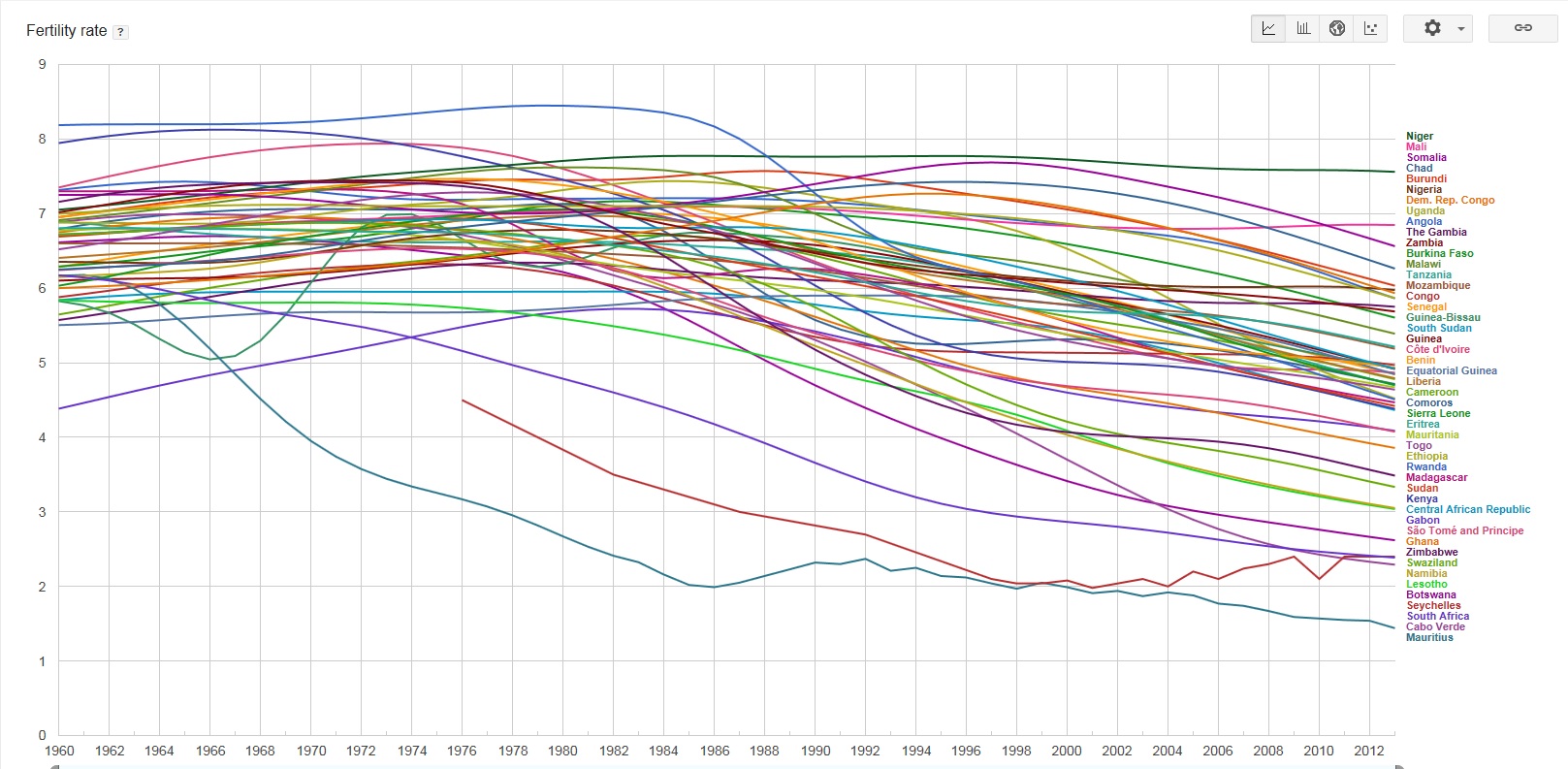
First, he based his argument on the fertility rates of one country (Nigeria), which seems to be an exception rather than a rule when each SSA country is examined individually. Most countries show a downward trend in their fertility rates (see below). Moreover, basing one’s argument on one country only is hardly convincing giving the huge variation in fertility rates in the region: from 1.44 in Mauritius to 7.56 in Niger.

All Sub-Saharan African Counties (click for a better graph).

all SSA TFR

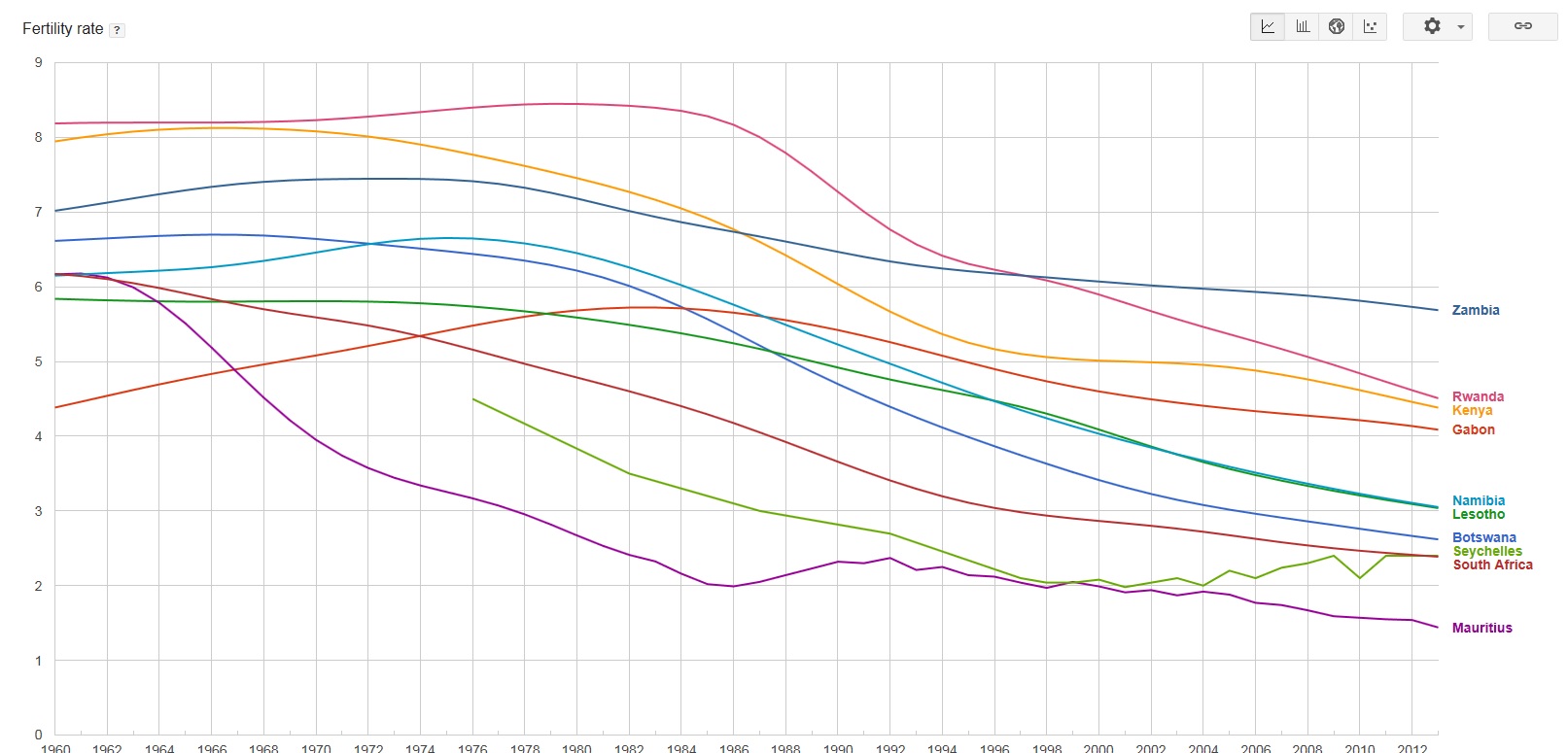
According to World Economic Forum (WEF), the most promising economies in SSA are found in Mauritius, South Africa, Rwanda, Botswana, Namibia, Kenya, Seychelles, Zambia, Gabon and Lesotho. WEF’s ranking includes measures of education, health care and infrastructure in addition to more traditional economic measures. Fertility rates have decreased markedly in all these countries, six out of ten being at around three children per woman or less, emphasising the importance of fighting poverty and providing health care and education in order to reduce fertility rates.

Top ten economies in the region (click for a better graph).

best economies SSA TFR

According to UN population projections, it is true that the world’s population will keep growing for some time still and the fastest growth is in Sub Saharan Africa. The smallest changes in fertility may cause big differences in population size a few decades later, so projecting population is a very difficult task, like the graph below, put together by the most prominent professionals in the field, shows.world population

Instead of throwing out arguments about Nigerians or anyone else not being able to “achieve” lower fertility rates due to following the instructions of their religious leaders, it would be more useful to think why fertility rates differ so drastically around the world. The important thing is to figure out how we could ensure a better future for everyone in terms of economic prosperity, health care, education and social safety nets.

Raskaudenkeskeytystä hakevan naisen oikeudet tärkeämpiä kuin hoitohenkilökunnan vakaumukset

Huomenna 8. lokakuuta 2015 eduskunnassa on lähetekeskustelussa laki joka koskee kansalaisaloitetta lakisääteisestä oikeudesta kieltäytyä “elämän lopettamisesta” (suora lainaus eduskunnan sivuilta) terveydenhuollon henkilökunnalle vakaumuksellisista syistä. Todellisuudessa lakiehdotus tarkoittaisi hoitohenkilökunnan mahdollisuutta kieltäytyä hoitamasta naista, joka hakee raskaudenkeskeytystä.

Ensikuulemalta lakiehdotus ei ehkä kuulosta kovin pahalta. Suomessahan voi aina hakeutua toisen lääkärin puheille, mikäli ensimmäinen sattuu vakaumuksellisista syistä vastustamaan aborttia. Todellisuudessa kyseisellä lainsäädännöllä on huomattu olevan useita negatiivisia vaikutuksia maissa, joissa se on olemassa.

Lainsäädännön haittavaikutuksia vähätellään usein sanomalla, että vain pieni osa lääkäreistä ja muusta hoitohenkilökunnasta kieltäytyisi hoitamasta potilaitaan. Kuitenkin esimerkiksi Italiassa keskimäärin 70% gynekologeista on kieltäytynyt aborttien tekemisestä (1). Joillain alueilla jopa yli 80% ei tähän toimenpiteeseen suostu (2). Laki asettaa naiset eriarvoiseen asemaan ja vaikeuttaa hoitoonpääsyä etenkin kaupunkien ulkopuolella, missä vaihtoehtoisia palveluita voi olla vaikeaa löytää.

Usein lakia perustellaan säälimällä hoitohenkilökuntaa, joka joutuu toimimaan vastoin uskonnollista vakaumustaan. Vaikka asia heille varmasti vaikea onkin, on muistettava, etteivät hoitoon hakeutuvat naiset ja hoitohenkilökunta ole tasa-arvoisessa valta-asemassa. Suomessa naisen tulee jo nyt saada kahden lääkärin hyväksyntä abortille sosiaalisista syistä. Lääkärit toimivat portinvartijoina ja voivat käyttää valtaansa vaikeuttaakseen toimenpiteeseen pääsemistä. Ehdotettu lainsäädäntö ei ainakaan parantaisi tilannetta, vaan viestittäisi, ettei naisten tule saada itse päättää omasta kehostaan. Lainsäädännön tulisi puolustaa heikommassa asemassa olevaa, ei vaikeuttaa heidän asemaansa.

Olen jo aikaisemmassa kirjoituksessani korostanut, että pääsy turvallisiin raskaudenkeskeytyspalveluihin on tärkeää, sillä tämän oikeuden rajoittaminen ajaa naiset kotikutoisten menetelmien ääreen, mikä on riski heidän terveydelleen ja jopa elämälleen. Salliva aborttillinsäädäntö on yksi mutta ei ainoa tekijä naisten elämän turvaamisessa. Helppo pääsy raskaudenkeskeytykseen on toinen yhtä tärkeä tekijä.

Lakialoitteesta on puhuttu mediassa surullisen vähän huolimatta siitä kuinka tärkeä se on naisten oikeuksien kannalta. Pitäkää meteliä! Lain haittavaikutukset on tuotava esiin.

Muita aiheeseen liittyviä tekstejä:

Marianne Niemelä, Vihreä Lanka: Miksi joudumme yhä taistelemaan aborttioikeudesta?

Väestöliitto: Ei omantunnonvapautta raskauden keskeytyksiin.

Lähteet

  1. Chavkin et al. 2013. Conscientious objection and refusal to provide reproductive healthcare: a White Paper examining prevalence, health consequences, and policy responses. International Journal of Gynecology and Obstetrics.
  2. Fiala & Arthur 2014. “Dishonourable disobedience” – Why refusal to treat in reproductive healthcare is not conscientious objection. Woman – Psychosomatic Gynaecology and Obstetrics.

How to define top journals in social science? The example of demography.

Inspired by a blog post by Patrick Dunleavy about citation practices in different disciplines I wanted to update my understanding of which journals belong to the top of my discipline, demography.

Traditionally I have checked this using the impact factor scores listed in ISI Web of Social Science’s Journal Citation Reports under group “Demography”. I knew that impact factor is in fact quite a bad indicator of a journal’s prestige, but I kept focusing on that anyway. I simply assumed that everyone else was doing that as well and thus the socially constructed understanding of which journals are the best ones would be based on impact factor rankings despite its problems. As a young researcher I have to be constantly thinking about my CV and I thought submitting to journals that rank high on this indicator would impress a potential employer reading my list of publications.

However, Professor Dunleavy wrote that anyone still looking at impact factors is “mathematically ignorant”, whereas h-indices listed in Google Scholar’s Metrics are “robust and meaningful average indicators”. In addition, he said that coverage of social science journals is much better in Google’s than ISI Web’s database. Consequently, I decided to see what Google Metrics had to say about demography.

Unfortunately Google Metrics does not have a subcategory for demography, so I was only left guessing whether the coverage actually is any better in my discipline. Instead, I decided to search for the top 20 journals listed by ISI Web and see what happens to the rankings when h-index is used instead of impact factor.

The table below shows that regardless of the metric the top two journals in demography are Demography and Population and Development Review. There is more variation in the raking of other journals, for instance the open source Demographic Research’s rankings vary from 5 to 11 and the London based Population Studies’ from 8 to 17.

journalranks

So, what did we learn from all this? Where should I submit my next article? I guess we are still in search of the perfect metric and journal database, but the results seem to be fairly robust at least when it comes to the few journals at the very top of the rankings.

If one wants to maximise the h-index/impact factor of their publications, and happens to work in an interdisciplinary field like demography, they’re probably better of publishing in journals listed under other disciplines, such as sociology (e.g. American Sociological Review has H5 index of 47) or epidemiology (e.g. H5 of American Journal of Epidemiology is 73).

I guess in the end it all comes down to varying citation traditions discussed in Dunleavy’s blog post. Perhaps we all should just start vigorously citing research published in our field?

Whose life matters? Spain’s abortion bill

Spain is about to pass a bill called “The Organic law for the protection of the life of the conceived and the rights of the pregnant woman” into the parliament for debate. The bill suggests restricting access to abortion only in rape cases or if the woman’s health is at risk. The bill not only violates human rights, but will also put a number of women into a severe risk. Unsafe abortion is often fatal.

Studies have shown that restrictive abortion laws do not reduce the number of abortions. In a paper published in The Lancet in 2012, Gilda Sedgh and colleagues showed that abortion rate was lower in those regions of the world, where legislation was liberal.

In many countries, where access to safe abortion is restricted, women use life threatening methods to terminate unwanted pregnancies. These range from black market drugs to inserting unhygienic objects, such as sticks, to vagina in order to induce the abortion. Around 13% of maternal deaths are due to unsafe abortion, resulting in the death of almost 50,000 women every year. In developing countries, where access to abortion is often restricted by legislation, lack of appropriate health care facilities, or both, around five million women per year are treated due to complications due to unsafe abortion.

Adverse health consequences of unsafe abortion can easily be prevented by providing easy access to contraceptives and safe abortion services.

Please sign Amnesty’s petition against Spain’s abortion bill. Finns can do it here, others please check your local Amnesty International, or write directly to Spanish Politicians (see instructions here) before 24 July 2014.

Academic articles:

Other sources: